I grew up on classic films. The early days of horror in the film industry were some of the most groundbreaking, thought provoking, and mind bending times for the film genre. Nowadays, it's all about the shock value rather than the atmosphere of a film. That can honestly be a depressing thought when you grew up on classics.
When younger people today look at the earlier versions of some titles, such as House of Wax, they don't see the appeal.
Today, I'm here to tell you why these films should still be regarded as some of the scariest, and greatest, films of our time.
#1: Psycho, Alfred Hitchcock, 1960
Alfred Hitchcock has always been and always will be one of the masters of suspense. Films such as The Birds, Rear Window, and Strangers on a Train have seriously become underrated in today's shock driven society.
It is understandable that as years pass, directors have to up the anti when it comes to inciting fear in their audiences. However, without directors like Hitchcock, they wouldn't have a clue about where to start.
Released in 1960, the film was based off of the 1959 novel of the same name written by Robert Bloch. The film follows Marion Crane, played by Janet Leigh, after she steals a great sum of money from her job and goes on the run. Marion finds herself in the middle of nowhere and decides to spend the night at the Bates Motel. With seemingly no one around but the hotel's proprietor, Norman Bates, played by Anthony Perkins, Marion decides this is a safe place to hide for now. However, it becomes apparent to the audience that Norman and his so far hidden mother may not exactly be the healthiest of people. Deciding to stay under the circumstances turns out to be Marion's biggest mistake, as she is murdered, seemingly by Norman's mother, while taking a shower. The rest of the film follows the investigation into Marion's death, and the shocking twist at the end is one that left audiences rattled for years to come.
The great thing about this film is its atmosphere. One thing that audiences lack nowadays is patience. The desire for instant gratification is far too high. For the time, even the first 40 minutes of the film gave audiences a feeling of great suspense.
Would Marion get away with her crime? Who is Norman's mysterious mother, and what are she and Norman hiding?
It's questions like these that kept audiences captivated up to that iconic shower scene. And it's that build up that should keep people engaged when watching a film, it's what makes films great to watch. Movies are like books that have come to life, a true statement for this one in a sense.
It isn't just the atmosphere of the film that creates suspense. It's Hitchcock's clever use of camera angles, lighting, and even a lack of music. Music in films is often used to build suspense, but silence on the other hand lets a viewer create that through visuals alone. That's what Hitchcock did well with many of his films, but Psycho takes the cake for the best use of these techniques.
It's no secret either that Norman Bates himself was based on real life serial killer, Ed Gein. Taking inspiration from one of history's most prolific serial killers is bound to create an unforgettable character. To this day, the final frame of the film has become just as iconic as the shower scene before it.
#2: House of Wax, Andre DeToth, 1953
While perhaps not as iconic as Psycho, the 1953 film House of Wax was still quite the film. One of my personal favorite Vincent Price appearances, House of Wax took atmosphere and elevated it into the realms of disturbing for the time.
A combination of clever uses of lights, sounds, and the amazing performances by the actors make this film a highly underrated horror classic.
The story centers around Professor Henry Jarrod, played by horror movie icon Vincent Price, who is a talented wax sculptor at a museum. He specializes in historical figures and has an intense passion for his work. When his business partner, Matthew Burke, played by Roy Roberts, demands that he make more sensational displays to increase profits, Jarrod refuses. After Jarrod gives a private tour of the museum to a man who intends to buy the museum under Burke's nose, Burke sets the museum on fire intending to claim money from insurance.
Jarrod survives the fire, but comes out just as twisted and mangled as the figures he so loved. Rising from the ashes, Jarrod builds a new museum, and inevitably decides to create more popular displays. How he does this is part of the film's miraculous ending twist.
The thing that I personally love so much about this film is its subtle hinting at what's really going on. While you may know from the beginning what's going to happen, little things throughout keep you second guessing yourself until the final reveal. When that moment comes, it's a delicious shock for the mind.
Not only is this film creative and innovative in the way it presents its story, it takes the viewer for a good ride and has you feeling ultimately sympathetic for the main villain.
That's another thing, a sympathetic villain is always the most shocking villain. If you're made to feel empathy for a monster hiding under human flesh, the payoff when he's revealed is that much more shocking.
#3: Night of the Living Dead, George A. Romero, 1968
Widely regarded as the first real zombie apocalypse film, the original Night of the Living Dead is a horror classic that has become highly underrated considering today's obsession with undead flesh eaters.
George A. Romero did it right with this film in every possible way. With this film, he revolutionized the horror genre and created the foundation for which many horror films built themselves upon for generations to come.
The story follows Barbra, played by Judith O'Dea, and Johnny Blair, played by Russel Streiner (though he's not credited as his part is very brief) as they drive to rural Pennsylvania to visit their father's grave. While there, Barbra is attacked and Johnny tries to save her. However, Johnny is killed after having his head struck on a headstone. Barbra escapes the attacking stranger and finds herself in a farm house. Inside, she finds the tattered remains of a woman and tries to flee. Unfortunately, outside she meets another stranger similar to the one who attacked her. She then encounters Ben, played by Duane Jones, who takes her back into the house, barricades them inside, and drives the monsters away. The rest of the film follows them and more characters they meet as they try to survive the horrors that await them on the outside.
This film took what shock value SHOULD be and gave it to audiences with no apologies. The thing about shock value is that it needs build up to be powerful. That is what this film did well. While you're not entirely sure in the beginning what is going to happen or what these creepy strangers want, when you find out what they are it becomes all the more shocking to you.
Not only that, but the fear of the unknown is what drives a lot of horror films to be great. This film's use of that kind of mystery creates an atmosphere that sucks the viewer in for a more immersed experience.
#4 Nosferatu, F.W. Murnau, 1922
Great films from the Silent Film Era have gone so far under the radar in recent years. It's quite depressing. Considering that, without them, the movies of today wouldn't even exist. These films built the foundation for which future generations of film would be built upon.
In terms of horror, the ever iconic 1922 film Nosferatu was groundbreaking for future films involving the undead.
This film follows a Germany based real estate associate named Hutter, played by Gustav von Wangenheim, as he is dispatched to the castle of Count Graf Orlak, played by Max Schreck. The Count wishes to purchase and isolated home in Wisbourg, and it is decided that Hutter's company will sell a home located right across from his own. The locals surrounding Orlak's home refuse to go near the castle, as there have been many strange things happening there. Eventually, Hutter makes it to the castle and convinces the Count to buy the home. However, Hutter notices that there is something strange about the Count and his home. Hutter becomes trapped at the castle while Orlak, transporting himself inside a coffin, makes his way to Wisbourg leaving a trail of death behind him.
The film is loosely based on Bram Stoker's 'Dracula'. I say loosely based because the rights for the story were never authorized. Names were changed and certain characters from the original story were omitted and the director and producers took their own creative liberties to create one of the most iconic horror films in history.
Because it is a silent feature, the film was set to a score composed by Hans Erdmann. However, much of the original score has been lost. Thus many versions of the film that are available have new scores added to keep the original essence of the film intact.
As mentioned before, sometimes all that is needed is silence or music to create the perfect atmosphere for a film. With Nosferatu, this rings true as that was all that was available for the time, and the creators of this film made the absolute most of what they had. Creating a film with suspense to draw audiences in wasn't always easy. Nowadays, nobody would have the patience to sit through this film and appreciate it unless they truly understand that. There are many moments where there is no dialogue, there are only visuals and the talents of the actors in the film.
There are moments in this film that are HEAVY with anxiety, you can truly feel Hutter's dismay when he discovers the Count's secret. You become drawn in to what's going to happen next. You anticipate each and every move the Count makes and you root for the people fighting against him. It's a highly underrated film these days.
I tried showing this film to some friends of mine, also horror buffs, and they couldn't keep their attention on it at all. This is highly disappointing. The films they praise are ones that have no grasp of story, no concept of creating a rich atmosphere to immerse the viewer in. It's disappointing that while we have come so far with making movies, the simplest of techniques are lost in a lot of today's films.
The thing that makes Nosferatu so great is that while it had very little to work with at the time, what it created became so recognizable, so iconic that just mentioning the name of Nosferatu sets the image of that tall, spindle-fingered, sharp-toothed, gangly creature in a person's mind.
When you want to make a film great, you make it the way that these people made Nosferatu. They didn't try too hard, and the result was a beautiful piece of film that always looks as if it was found in a time capsule.
#5: House on Haunted Hill, William Castle, 1959
When it comes to psychological horror, this movie is an absolute go-to if you want to take a look at one of the most brilliantly made films of all time. The remake of this film was so disappointing and really didn't even try to hold on to what made this film so powerful.
In this movie, we follow millionaire Frederick Loren, portrayed by the always brilliant Vincent Price, as he invites five unsuspecting people to a party at an allegedly haunted house. He promises to award each of them the sum of $10,000 as long as they stay for the entire night after the doors are locked at midnight. Frederick's wife, Annabelle, played by Carol Ohmart, warns the guests that her husband is scheming something and that she suspects he has murdered his previous wives. What follows is a night that none of the patrons will ever forget.
When you want to delve deep into the human mind, you've got to do it the way that this film did. The analytical look at what different people will do in a certain situation, how they will react to fear and what it does to their minds is absolutely fascinating. To see how five different people handle different levels of stress, what they will do when confronted by something they never expected, it grabs you and pulls you in. It thrusts you right into their shoes and makes you feel everything they're feeling.
It makes you wonder, what would you do? How would you handle these kinds of situations yourself? Films that make you think are the ones that stand the test of time as great films. This one is so fascinating, it's definitely going to stay on par with the films of today no matter how many years pass.
While we as a society have become desensitized to a lot when it comes to horror films, we can't deny that films such as these have laid down the stepping stones to what movies are today. Even if you DON'T feel a twinge of fear when you watch them anymore, you can at least look back and appreciate what they did for what we have now. The legacy they've left is one that we can honestly say will never be broken, no matter how far we continue to grow.
The Darker Alternative
Saturday, July 21, 2018
Thursday, July 19, 2018
5 Silent Hill Bosses and What They Represent
Everyone loves a good video game. Some people, though, like to travel on the dark side of the gaming community and delve into the strange and unknown. The fear response in the human brain, for these people, can be quite addicting. The worlds these people like to dive into can be gory, gritty, the stuff of nightmares.
Especially when it comes to the brilliant, and possibly disturbed, minds behind the games of the Silent Hill franchise.
Since the first game's release in 1999 for the Playstation, horror fans all over the world have reveled (And screamed like little children.) at the creative and eerie monsters produced by Team Silent. These people knew just what to do to create a horrific, foreboding environment for players to move around in.
Some of their pinnacle achievements in the games were the bosses. I'm taking a look at 5 of them today to see where exactly these monsters came from. What caused them to manifest? What, in terms of how this franchise's world works, created them?
#1: Scarlet, Silent Hill Homecoming
I remember when I first played this game. I was so used to the monsters of Silent Hill's past. Personally, I wasn't particularly impressed with this installment. It had its moments, but I was otherwise underwhelmed.
Then, I came upon this tangled up monstrosity. LOOK at that FACE! Dolls are scary; a lot of people think so. Team Silent took that notion and made this gangly, fierce beast into one of the most annoying, and terrifying, bosses in video game history.
Scarlet is the second major boss encountered in the game. Metaphorically, Scarlet represents the memory of Scarlet Fitch, the daughter of Dr. Martin Fitch. The beast herself is a physical manifestation of her father's guilt for sacrificing his daughter in such a horrific way. (Play the game if you want the gory details on that, it's quite chilling.)
If you've played this game, you probably noticed there's a LOT of blood during the boss fight. This is a huge metaphor for the way that Scarlet died. Even at the end, her father sinks into a pool of blood, representing just how much she probably lost when she herself perished.
A lot of thought goes into something like that. A lot of deeply...deeply disturbed thought. But, kudos to the creators for not only making something so innately terrifying, but really kind of sad when you think about it in terms of what happened to the poor girl.
#2: Red Pyramid (Pyramid Head), Silent Hill 2
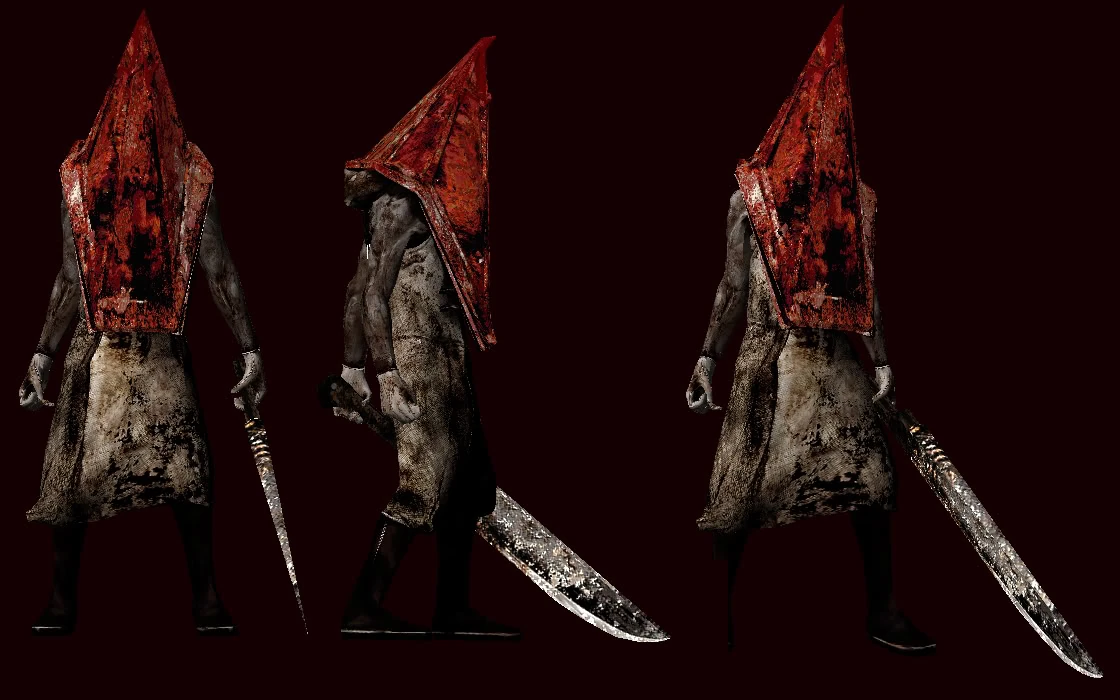
As you move through the rest of the game, each new encounter with him makes him seem more and more dangerous. At the very end, you must face a pair of these creatures before you can finish at last. But, what does he represent?
It's clear from playing that you learn about the main character, James Sunderland, killing his wife as a way to release her (And himself) from the burden of her terminal illness. It is well known that Pyramid Head is a manifestation of James' guilt for killing his wife and not having been punished for doing the deed.
In the game, the pair that appear at the end murder Maria, a character you encounter during your time in Silent Hill. This is done to remind James of what he has done and force him to face it. There are a few times that Maria appears to have been killed, each time is to remind James of this act. The third and final time forces him to accept this fact. Once the boss fight is done, the two Pyramid Heads impale themselves, representing the cessation of the task they set out to do; Reminding James that he took the life of his ill spouse.
#3: Sad Daddy, Silent Hill Origins
Especially when it comes to the brilliant, and possibly disturbed, minds behind the games of the Silent Hill franchise.
Since the first game's release in 1999 for the Playstation, horror fans all over the world have reveled (And screamed like little children.) at the creative and eerie monsters produced by Team Silent. These people knew just what to do to create a horrific, foreboding environment for players to move around in.
Some of their pinnacle achievements in the games were the bosses. I'm taking a look at 5 of them today to see where exactly these monsters came from. What caused them to manifest? What, in terms of how this franchise's world works, created them?
#1: Scarlet, Silent Hill Homecoming
I remember when I first played this game. I was so used to the monsters of Silent Hill's past. Personally, I wasn't particularly impressed with this installment. It had its moments, but I was otherwise underwhelmed.
Then, I came upon this tangled up monstrosity. LOOK at that FACE! Dolls are scary; a lot of people think so. Team Silent took that notion and made this gangly, fierce beast into one of the most annoying, and terrifying, bosses in video game history.
Scarlet is the second major boss encountered in the game. Metaphorically, Scarlet represents the memory of Scarlet Fitch, the daughter of Dr. Martin Fitch. The beast herself is a physical manifestation of her father's guilt for sacrificing his daughter in such a horrific way. (Play the game if you want the gory details on that, it's quite chilling.)
If you've played this game, you probably noticed there's a LOT of blood during the boss fight. This is a huge metaphor for the way that Scarlet died. Even at the end, her father sinks into a pool of blood, representing just how much she probably lost when she herself perished.
A lot of thought goes into something like that. A lot of deeply...deeply disturbed thought. But, kudos to the creators for not only making something so innately terrifying, but really kind of sad when you think about it in terms of what happened to the poor girl.
#2: Red Pyramid (Pyramid Head), Silent Hill 2
The most iconic figure from the franchise is, and always will be, Pyramid Head. While he may have been overused in the film adaptations, and had an (Honestly) unnecessary appearance in Silent Hill Homecoming, he is still one of the most terrifying beings to walk the streets of Silent Hill.
Making his appearance in the second installment of the games, Pyramid Head slinked his way into every gamer's memory, and with good reason. The first time you see him...
It's clear from playing that you learn about the main character, James Sunderland, killing his wife as a way to release her (And himself) from the burden of her terminal illness. It is well known that Pyramid Head is a manifestation of James' guilt for killing his wife and not having been punished for doing the deed.
In the game, the pair that appear at the end murder Maria, a character you encounter during your time in Silent Hill. This is done to remind James of what he has done and force him to face it. There are a few times that Maria appears to have been killed, each time is to remind James of this act. The third and final time forces him to accept this fact. Once the boss fight is done, the two Pyramid Heads impale themselves, representing the cessation of the task they set out to do; Reminding James that he took the life of his ill spouse.
#3: Sad Daddy, Silent Hill Origins
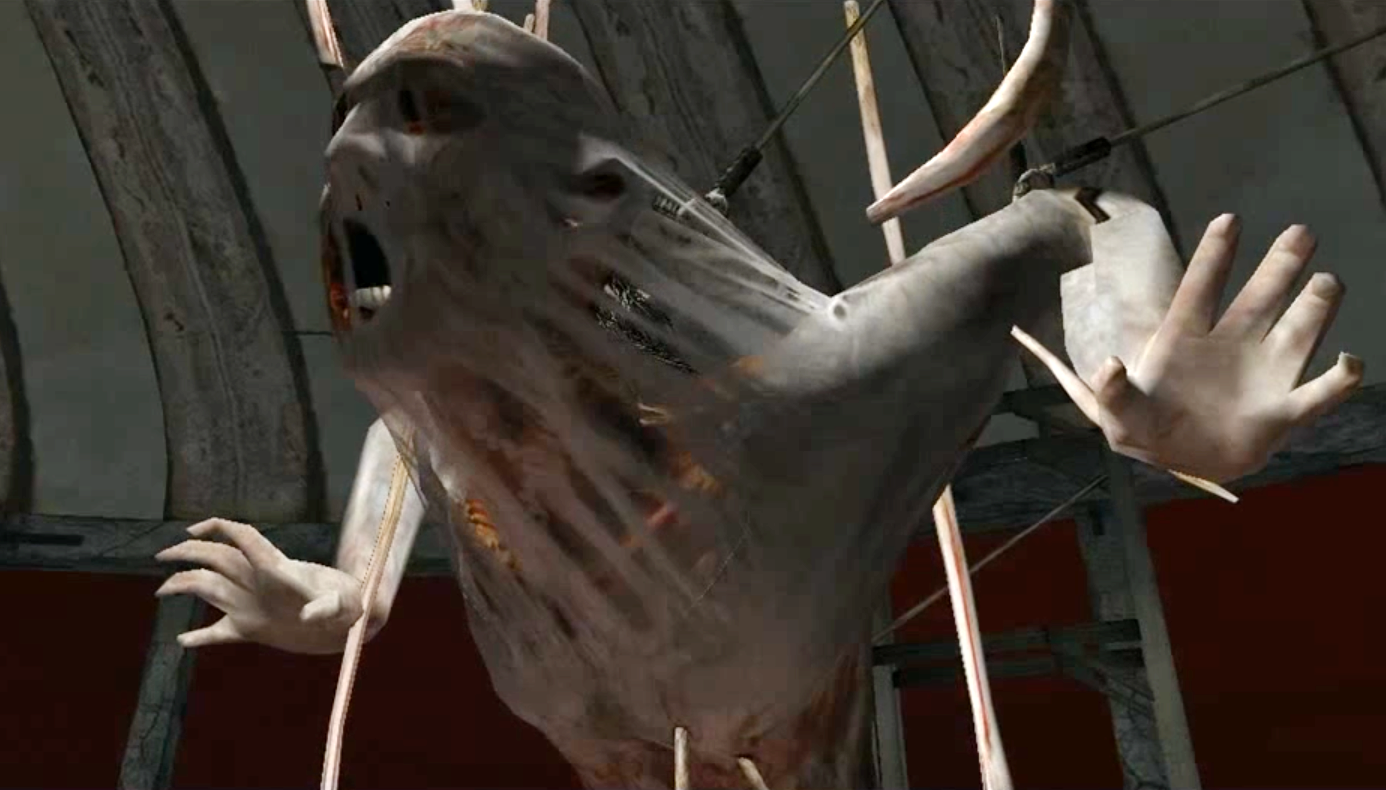
My personal favorite installment of the series, Silent Hill Origins, had a handful of familiar faces in it, with its own unique bosses. This one in particular always struck a chord with me, though. Its whole appearance just gives me shivers, if I'm being brutally honest. Sometimes, I even feel a little sick when thinking about the first time I played through this part of the game.
The whole history of the main character, Travis Grady, isn't exactly a tale full of gum drops and roses. His mother went insane, his father took his own life, and it's learning that that brings us to this ungodly monstrosity.
As I've stated, this boss is a representation of the memory of Travis' father, Richard Grady, and the guilt and responsibility Travis feels for his death. While it really isn't Travis' fault that his father committed suicide, it's still a hard wound to tend to. Understandably so.
Travis found his father hanging in a noose, which can be seen represented in this boss' design. This corpse-like figure kind of dangles from the ceiling, as a body would from a noose. Heck, during the boss fight there are tentacles that will attempt to grab Travis around the neck, representing how his father took his life.
This monster is another in a long line of creatures from the games that aren't just freaky, they're actually very sad.
#4: Conjurer, Silent Hill 4: The Room
Silent Hill 4 was another somewhat unpopular installment. While not your typical romp in Silent Hill, this game still had a lot to offer in the story department.
The main character, Henry Townsend, is trapped in his apartment and often finds himself in a series of supernatural worlds. Eventually, he goes head to head with an undead serial killer, Walter Sullivan.
There are a lot of noteworthy moments in the game, despite not taking place in the town of Silent Hill at all. The game still had the spirit of the previous games to make it a thought provoking and gut churning experience.
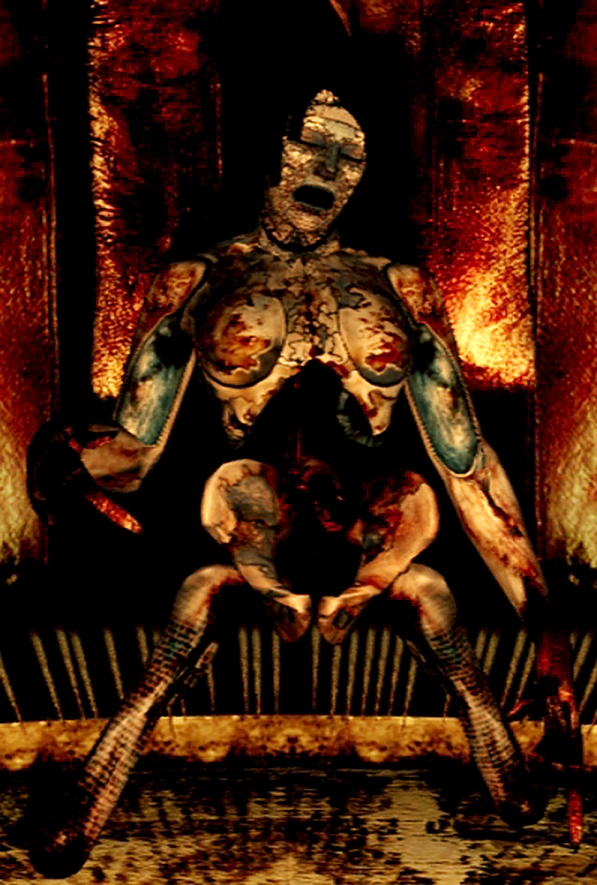
None, though, like this piece of work. I, personally, hated playing against this boss. He wasn't the most difficult to beat, but good lord almighty the things he brings about are just annoying. This beast conjures up the ghost of Walter Sullivan, who's the real threat in this fight, and he [the ghost] can be kind of frustrating to get at.
Conjurer itself represents Walter himself and everything he desires. Room 302, which Walter believes is his "mother" is where this boss calls home. That in itself suggests that, considering Walter's ghost comes out of this thing, represents his mother's womb. Considering this thing's monstrous appearance, it could also be a physical manifestation of Walter's monstrous nature as a serial killer.
#5: God, Silent Hill 3
Silent Hill 3 is widely regarded as the darkest of the series, and with good reason. With heavy religious undertones and casting the first female main character of the series, Silent Hill 3 took a deeper look at what really happened to that last little bit of innocence that left Silent Hill before it became the hell storm that it was when we first encountered it.
Heather Mason, the teenager grown from the baby Harry Mason took from the ending of the first game, is our lead here. When she comes across this boss, the whole encounter is anything but pretty.
The whole way this creature came about is an entire story of its own, and there are several deep meanings to this creature.
The fight between God and Heather has been said to represent Heather overcoming her dark past as Alessa and her desire to rid the world of the influence that the Order had over the rest of the world.
The boss battle itself takes place underground, which suggests that God itself is closer to mankind than the traditional Christian God. It's here on Earth, closer to Hell itself rather than heaven.
There are a dozen different theories about what this particular boss could symbolize. Each one, while they make sense story-wise, is more disturbing than the last.
To me, personally, that is what makes this boss so unique and frightening. If you've played the games, you understand.
If you HAVEN'T played the Silent Hill games, I strongly encourage you to give them a try. While they are dark, and highly disturbing, they're also highly thought provoking. Psychological horror is probably one of the most popular sub-genres of horror that exist because it invokes such deep thought. That's why these games are my favorites.
Except for Downpour. Don't play that game. That game was an abomination to the series.
5 Songs From the 1990's That Are Actually Pretty Disturbing
If you're anything like me, you grew up on the grungy alternative rock songs of the '90's. Bands like Pearl Jam, Live, and Nirvana (To name a few.) have some pretty classic songs for some kids who grew up during that particular decade. Yet, have you ever stopped to listen to some of the lyrics to these songs? Or have you ever taken the time to do some research into what they mean?
Some of these songs actually have some dark history to them. Let's dig through this dark, creepy, sometimes even gory playlist and dig deep into these 10 pretty disturbing songs of the 1990's.
#1: Jeremy by Pearl Jam
This iconic song by the Seattle, Washington based American rock band has one of the most disturbing back stories of all time. When listening to the song initially, it's clear that the song has dark undertones. However, when you dig a little deeper, the truth about the song gets rather bloody.
There are two very true, and heartbreaking, stories that run in the verses of 'Jeremy'. The first of which gives the song its name.
The tale of 16 year old Jeremy Wade Delle from Richardson, Texas is a truly shocking one. The young boy took his own life in front of his class mates with a Smith & Wesson 19-4 .357 Magnum on the morning of Tuesday, January 8th in 1991. Eddie Vedder, the band's front man, mentioned in an interview that he had felt the need to take the article about Jeremy and make something of it.
In the second verse of the song, Vedder sings about another true story. However, this one is closer to home. This time, Vedder sings about a classmate from his days in Junior High School. This boy, instead of taking his own life, decided to take a gun and shoot up an oceanography room. Vedder recalls that he heard the shots from where he was in the school. He had actually had altercations with the boy in the past.
Essentially, the song is about two boys. Both of whom were very disturbed and took their revenge out on a world that had shunned them in two very different, but equally violent ways.
When you really look at the story of Jeremy Delle in particular, the lyrics "Jeremy spoke in class today" and "Try to erase this from the blackboard..." suddenly become way, way more foreboding.
#2: Rape Me by Nirvana
Perhaps the most controversial song by one of the most influential rock bands of the 1990's, Nirvana, is a tale of poetic justice.
The song itself was conceived to make a powerful statement in support of women and the violence that is often (Too often.) brought down upon them. In the words of lead singer and guitarist Kurt Cobain, it's the story of a man who rapes a woman, is sent to prison for it, and is himself raped while he is there. Cobain also mentioned that there is a direct parallel with the song "Polly", which is a song told from the point of view of the rapist.
It was theorized by fans and lyrical analysts that the song can also be interpreted as an expression of Cobain's feelings of being raped by the media.
Either way, one listen of this song can make even the most hardened person a little queasy. The phrase "rape me" sung over and over in an almost accepting, yet defiant, tone can set anyone's teeth on edge.
#3: One by Metallica
#5: Spice Up Your Life by The Spice Girls
Some of these songs actually have some dark history to them. Let's dig through this dark, creepy, sometimes even gory playlist and dig deep into these 10 pretty disturbing songs of the 1990's.
#1: Jeremy by Pearl Jam
There are two very true, and heartbreaking, stories that run in the verses of 'Jeremy'. The first of which gives the song its name.
The tale of 16 year old Jeremy Wade Delle from Richardson, Texas is a truly shocking one. The young boy took his own life in front of his class mates with a Smith & Wesson 19-4 .357 Magnum on the morning of Tuesday, January 8th in 1991. Eddie Vedder, the band's front man, mentioned in an interview that he had felt the need to take the article about Jeremy and make something of it.
In the second verse of the song, Vedder sings about another true story. However, this one is closer to home. This time, Vedder sings about a classmate from his days in Junior High School. This boy, instead of taking his own life, decided to take a gun and shoot up an oceanography room. Vedder recalls that he heard the shots from where he was in the school. He had actually had altercations with the boy in the past.
Essentially, the song is about two boys. Both of whom were very disturbed and took their revenge out on a world that had shunned them in two very different, but equally violent ways.
When you really look at the story of Jeremy Delle in particular, the lyrics "Jeremy spoke in class today" and "Try to erase this from the blackboard..." suddenly become way, way more foreboding.
#2: Rape Me by Nirvana
The song itself was conceived to make a powerful statement in support of women and the violence that is often (Too often.) brought down upon them. In the words of lead singer and guitarist Kurt Cobain, it's the story of a man who rapes a woman, is sent to prison for it, and is himself raped while he is there. Cobain also mentioned that there is a direct parallel with the song "Polly", which is a song told from the point of view of the rapist.
It was theorized by fans and lyrical analysts that the song can also be interpreted as an expression of Cobain's feelings of being raped by the media.
Either way, one listen of this song can make even the most hardened person a little queasy. The phrase "rape me" sung over and over in an almost accepting, yet defiant, tone can set anyone's teeth on edge.
#3: One by Metallica
Perhaps one of the most popular rock bands of all time, Metallica actually released this little rosebud in 1988. However, as the band grew in popularity through the following decade, so did their songs.
When dissected this is a pretty sad and horrific song. It's about a World War 1 soldier who is hit by a landmine explosion that takes away his limbs and face. The soldier then becomes a prisoner in his own body and cannot even communicate anything to anyone around him.
Not to worry, though. This soldier is actually a character in the Novel 'Johnny Got His Gun' by Dalton Trumbo. That does take some of the weight off.
The song does, however, shed light on what some real life soldiers may be feeling when facing similar injuries. The lyrics themselves appear to be a plea for the soldier to be released from his despair; a cry to the void that he himself cannot physically make.
#4: Closer by Nine Inch Nails
This song by the Cleveland, OH native band, Nine Inch Nails, admittedly already has a pretty dark, grungy tone to it. On the surface, it appears to be purely sexual. Technically, it is.
Trent Reznor, the band's front man, equates the feeling of sexual fulfillment with being a heavenly experience. Thus, "You bring me closer to God" as a lyric.
However, it has been theorized that the sexual fulfillment aspect of the song equates to an escape not unlike drug or alcohol addiction. If you combine this with the theme of the rest of the album this single came out on ('The Downward Spiral'), which in itself is a combination of songs about self-loathing, suicide, and depression...this song suddenly takes on a whole new meaning.
Interpret it as you will. But it truly makes you stop and think when you know all of that, doesn't it?
#5: Spice Up Your Life by The Spice Girls
For many young girls, whether pre-teen, tween, elementary school age, and teenagers alike, The Spice Girls were the ultimate girl group. With the success of their first album and their movie debut in 'Spice World', these 5 ladies solidified their place in the 1990's hall of fame.
One of their most popular songs, 'Spice Up Your Life', seems to be a simple dance inspired tune that encourages everyone to "spice up" their lives. It seems innocent, and it's ridiculously catchy.
However, in recent years a theory has been circulating that the lyrics aren't just about encouraging their fans to have a good time. Apparently, according to some people, the lyrics are describing the process of making crystal meth and enjoying its effects. Allegedly, the lyrics "Slam it to the left" and "Shake it to the right" are apparently steps in the cooking process to make the lethal drug.
The song was used in a scene from the hit show 'Breaking Bad', sort of taking this theory from a mere shower thought to a sudden, and very possible, reality.
Apparently, neither the girls themselves nor the writers who helped with a majority of their songs have commented on the matter.
Perhaps we will never truly know if this is merely a wild fan theory, as there are so many floating around nowadays, or if this is what the song was really about. Either way, when you think about it and do a little bit of digging on how the drug is actually made, the dots connect a little TOO well.
While some are just theories, the songs that have confirmed their meanings really make you think about what your favorite song could possibly be about. Sometimes, it's fun to delve into the waters of a songwriter's mind and see where their inspiration came from. Other times, if you take a dip in there, you're going to find some sharks.
Subscribe to:
Posts (Atom)